
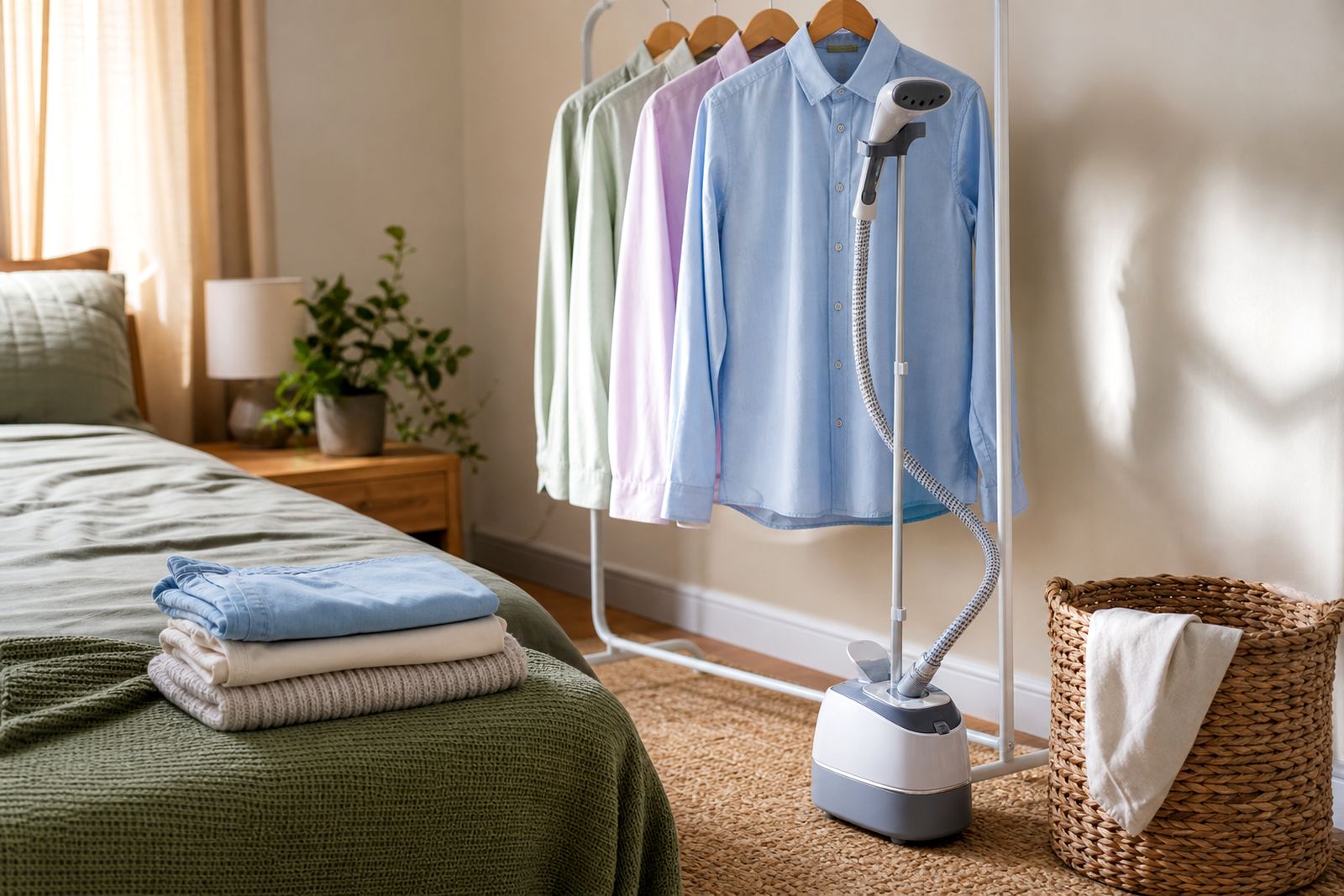
What a Handheld Garment Steamer Does
This tool uses heated steam to loosen creases and help fabrics hang properly again. It is handy for shirts, dresses, school uniforms, jackets, linen curtains and cushion covers, especially when you need a fast touch-up and do not want to press every item flat. Most units are light enough to hold with one hand, so they suit everyday use at home or in guest rooms, small businesses and retail prep areas.
Unlike a full-size iron, a handheld steamer works with the fabric hanging upright or laid flat on a suitable surface. That makes it useful for delicate materials, pleats, beadwork and garments that do not sit well under direct pressure. For many South African homes, it is also a good back-up during load-shedding because you can use it quickly when the power is back and get several items ready in one go.
- Refreshes clothing after storage or travel
- Helps reduce wrinkles on hanging curtains and throws
- Suitable for light touch-ups and daily fabric care
- Useful for delicate pieces that need gentle treatment
Sizes, Water Tank Options and Typical Output
Handheld steamers usually come in compact sizes with a water tank built into the body or attached as a small removable reservoir. Smaller units are better for a few garments at a time, while larger tanks suit regular use for families, hospitality settings or shared accommodation. When comparing options, look at tank size, heat-up time, steam rate and overall weight. A lighter unit is easier to hold, but a slightly larger tank can save time because you refill less often.
Typical output ranges from around 20 to 35 grams of steam per minute, depending on the model. Heat-up times are often between 20 seconds and 2 minutes. For most households, that is quick enough for morning prep, school uniforms and last minute outfit checks. If you deal with heavier fabric like denim or lined curtains, choose a unit with stronger steam output and a wider head for better coverage.
- Compact tank: around 100 ml to 150 ml for quick jobs
- Medium tank: around 200 ml to 300 ml for more items per fill
- Steam output: about 20 g/min to 35 g/min
- Heat-up time: usually 20 seconds to 2 minutes
Best Places to Use It at Home or on Site
A handheld garment steamer suits bedrooms, laundry rooms, retail back rooms, guest houses and small offices where presentation matters. In coastal areas such as Cape Town, Durban and Gqeberha, steam care can be useful for fabrics that pick up odours or sit slightly limp in humid conditions. In Gauteng, it is popular for getting clothes ready quickly on weekdays, especially when traffic and school runs leave little time for a full ironing session.
It is also a useful item for corporate gifting, hospitality kits and bulk purchases for teams that handle uniforms, event wear or display items. For curtains and soft furnishings, the steamer can help tidy up folds after washing or unpacking. It is not intended for heavy duty pressing of thick linen or large bedding loads, but for everyday refresh work it is a practical choice.
- Homes with limited storage space
- Guest houses, salons and small retail spaces
- Travel bags and weekend getaways
- Quick fabric refresh before meetings or events
Power Requirements and How to Use It Safely
Most handheld steamers run on standard household electricity and plug into a normal South African wall socket. Check the wattage before ordering, because higher wattage usually means faster heating and stronger steam, but it can also draw more power. If you live in an area with unstable supply or frequent outages, it helps to choose a model that heats quickly so you can use it efficiently once power is restored. Gas is not needed for this type of appliance.
For safe use, fill the tank with clean water only, allow the unit to heat fully, and keep the steam head moving so you do not soak the fabric. Use it upright where possible, and always test a small area first on delicate materials. Some fabrics can show water spots if the steamer is held too close, so a little distance makes a difference. Let the item cool before packing it away, and empty any leftover water after use if the maker's instructions call for it.
- Uses standard mains electricity, no gas needed
- Best used with clean water to reduce scale build-up
- Works well on hanging garments and upright curtains
- Always check fabric care labels before steaming
Care, Cleaning and Ongoing Servicing
Regular care keeps a steamer working properly. In many parts of South Africa, mains water can leave mineral build-up inside the tank or nozzle over time, so it is worth descaling the unit now and then if the manual allows it. Wipe the outside with a soft cloth, rinse the tank if needed, and make sure the vents stay clear. Do not store the unit with water still sitting inside for long periods, especially in humid coastal homes where moisture can linger.
If steam flow starts to weaken, check for blocked holes, limescale or a loose fitting. A good routine is to inspect the cable, plug and water tank before use, then give the unit a full clean after busy weeks. For businesses handling multiple garments a day, it is wise to keep a spare unit on hand so daily work does not stop if one needs servicing. Small repairs are often easier when the appliance has been kept clean from the start.
- Empty the tank after use when advised by the instructions
- Remove scale build-up if the water supply causes residue
- Keep the cord untangled and away from heat
- Store in a dry cupboard once fully cool
What To Check Before You Order
Before placing an order, check the tank capacity, wattage, heat-up time and whether the head is suitable for your main fabrics. If you want to steam curtains, choose a unit with a comfortable grip and enough steam output for longer hanging lengths. For regular clothing use, weight matters too because a lighter steamer is easier on the wrist. If you need it for a household, guest house or corporate setting, think about how often it will be used and whether a larger tank would save time.
It is also sensible to review the supplied accessories, such as a fabric brush, measuring cup or storage pouch. Look at the cable length if you plan to use it away from the nearest socket, and confirm the voltage is suitable for local supply. If you are buying for a team or for gifting, check the finish and packaging so it arrives ready for use. A clear product choice helps avoid returns and makes day to day fabric care much easier.
- Tank size and steam output
- Heat-up time and wattage
- Weight and cable length
- Accessories and storage extras
Key facts
| Product type | Handheld garment steamer |
|---|---|
| Use | Clothes, curtains, soft furnishings and light fabric refresh |
| Power | Electric mains operation, no gas required |
| Heat-up time | About 20 seconds to 2 minutes depending on model |
| Tank capacity | Usually 100 ml to 300 ml |
| Steam output | About 20 g/min to 35 g/min |